


Two MBA students died on Sunday, April 12th, apparently from a drug overdose at a rave-style concert. 6 people have been arrested, including the suspected drug peddler. The incident raises a bigger question on the relationship between live music and drugs- are we any safer when it comes to drug use in live music scenarios?
A critical MBA student from Jamnalal Bajaj Institute of Management Studies (JBIMS) in South Mumbai, Sheetal Salvi, recuperating from a suspected drug overdose, informed the police that she had had the same drug at another event in the city. The 25-year-old had reportedly taken ecstasy pills on April 11th at the ‘999999999 Warehouse Edition’, a rave-style concert at NESCO exhibition centre in Goregaon (East). Two other students, one from Lucknow, another from Delhi, died in the hospital the next day.
The event drew a crowd of 3000 to 4000 people, comprising mostly college students. The police arrested a 24-year-old real-estate developer, Anand Patel for allegedly supplying ecstasy, a day before the event to a student who distributed to others. Before Anand, there were five others on the list of people arrested, all accused of being part of the drug distribution circle. This includes the vice president of NESCO Exhibition Centre and a co-worker, an Inspiring Tie Production (production house for the event) employee, and two students of the college.
As reported by investigators, some students had taken the first dose before entering the venue, and another one during the concert. As the party started getting wilder, three of them started facing difficulties and collapsed.
Two Students Die During Treatment; College Friend Names Person Who Handed The Pill
The students were immediately rushed to Trauma Care Hospital, Jogeshwari. A stable student’s statement revealed the situation as consumption of the psychotropic substance, Ecstasy. One of them, Shreya Rai was declared dead during treatment. Around 7 am on Sunday, another youth, Bhasin, a resident of Churchgate, who was at the same show, was admitted to Life Line Medicare Hospital, Malad, also declared dead while undergoing treatment.
As per Salvi’s statement, her college friend Raunak Khandelwal handed her the pill. Raunak and another friend, Pratik was arrested on Monday.
The viscera of the deceased has been sent to the forensic laboratory in Kalina for chemical analysis. Officials said the exact cause of death will be confirmed only after the forensic reports are received.
All six accused have been booked under Section 105 (culpable homicide not amounting to murder) and other relevant provisions of the Bharatiya Nyaya Sanhita. The police have taken statements from 15 people, as further investigations continue.
According to recent updates, over 10 arrests have been made so far
This includes a security guard who allegedly accepted bribes to let them into the venue.
A recent breakthrough in the case revealed that a security failure at the venue facilitated the drug supply chain. Police recently arrested Pradip Gupta, a security guard at the NESCO center, for allegedly accepting bribes of Rs 1,000 each to allow pedlars into the concert without tickets or security checks. These pedlars, identified as Anand Patel, Vineet Gerelani, Shubh Agarwal, and Ayush Sahitya, are accused of distributing the narcotics directly to the students inside the venue.
The 11th accused in the case, bar dancer Jiya Jacob refused to cooperate with investigations and has been remanded in judicial custody. Authorities are looking for her partner Mahesh Khemlani who escaped abroad after the incident leaving a sudden unexplainable deposit of ₹14.95 lakh in liquid cash.

Music And Drugs – India: How Safe Are We?
As live music shows see a 200% escalation post-COVID in India over the last 2 years, we still have some difficult questions to face – how can we ensure more security? Last year, in December, the Cyberabad police raided a DJ Party, only to find 8 people test positive. Similar cases have been reported in Bengaluru and Delhi NCR, rave parties and high-end concerts.
Event management companies in India follow SOPs for concerts and public events. Apart from restrictions of age, bags are thoroughly checked, CCTVs monitor entrances and key areas, checks are done to ensure no weapons or arms or alcohol or bottles or metal is allowed inside. And warning regarding drugs, use of alcohol, tobacco are put up prominently. Consumers and ticket buyers are warned repeatedly that any consumption would be an offence.
However as per Sabbas Joseph, co-founder of Wizcraft Entertainment Pvt Ltd, “There is no way to check tablets or powder sachets, etc. This needs to be done by police checks as well as event security, and possibly regular non-intrusive methods are inadequate.”
Drugs in Live Concerts/Rave Parties: A Brief History of Music
If we go back in history, the use of drugs in music concerts is not a foreign idea. If we recall rock concerts like Woodstock ’99, the use of open drugs had led to an angry mob openly setting the space on fire, leading to a massacre. The event saw multiple women reporting getting raped and 3 confirmed deaths.

Coming to the electronic music scene, New York’s Camp Bisco, a major annual electronic music festival founded by The Disco Biscuits, had seen one person die of an overdose in 2011, and another fall into a coma in 2012. Leading to widespread criticism of the open-air drug market. In 2014, the festival was cancelled after severe issues with local authorities, including drug-related hospitalisations, arrests, and a lawsuit.
Also read: The Strokes’ Coachella Set Posed a Bold Political Statement
The 2023 Coachella Valley Music and Arts Festival in California had seen a large-scale problem of a similar nature. Over 100 festival-goers were hospitalized, and at least one woman died from a suspected overdose linked to rampant drug use at the festival. Drugs such as GHB, ecstasy (MDMA), cocaine, ketamine and fentanyl were used as per doctor reports.
Fentanyl outbreak, also called ‘Zombie Drug,’ is a major problem in LA streets. Multiple social media accounts confirm the drug has also reached Indian shores. Authorities are tightening defences against further infiltration into spaces prone to mass gatherings like live music venues.
The Bonnaroo Music and Arts Festival (Tennessee) & The Electric Daisy Carnival (Las Vegas)
Among modern-day music festivals, The Bonnaroo Music and Arts Festival in Tennessee remains another event that struggles with drug overdoses to date. In 2025, the Coffee County Sheriff’s Office and Manchester Police Department maintained a strong vigilance. They focused on drug enforcement in the campgrounds, with deputies conducting tent-to-tent patrols. Within the first half of the first day itself, the police made numerous arrests and citations.
Back in 2016, at the Bonnaroo Music festival, the police had arrested two individuals for possession with intent to distribute, seizing a substantial amount of substances, including 202 jars of THC oil, 241 bags of ketamine, 22 bags of cocaine, mushrooms, and over a thousand grams of marijuana.
We can see a similar issue at The Electric Daisy Carnival (EDC) at Las Vegas as well. Last May, two attendees died due to MDMA toxicity, according to the Clark County coroner. One attendee, a 39-year-old man, collapsed at the Speedway, while a 33-year-old man was found dead in his hotel room. 2025 saw 28 felony arrests. MDMA (molly/ecstasy) is the primary drug of concern at EDC, along with cases involving cocaine, ketamine, LSD, and fentanyl.
“PLUR” vs. “Sex, Drugs, Rock & Roll” – Are We Getting Back To The Drugs?
If we recall history, the 70’s through the 90’s, rock ‘n’ roll musicians have promoted it. More recently, the rave culture, more specifically, the electronic music scene like that of New York, has been witnessing it. When we think of music, drugs have always somewhat occupied a part of the experience, which we cannot easily ignore. Even if we consider the blues-jazz scene, around the 50s to 70’s, drugs have always remained a critical topic.


While rave’s central cultural slogan has been PLUR – Purpose, Love, Unity, Respect, is this just a show, or is this positive statement actually real? From what we see, we have a long way to go to just being positive.
No matter how much we focus on the positives, drugs have always been intertwined within the rave culture. Not that all rave artists engage in it, but illicit drug use has remained a concern. Be it with the music enthusiasts or performers.
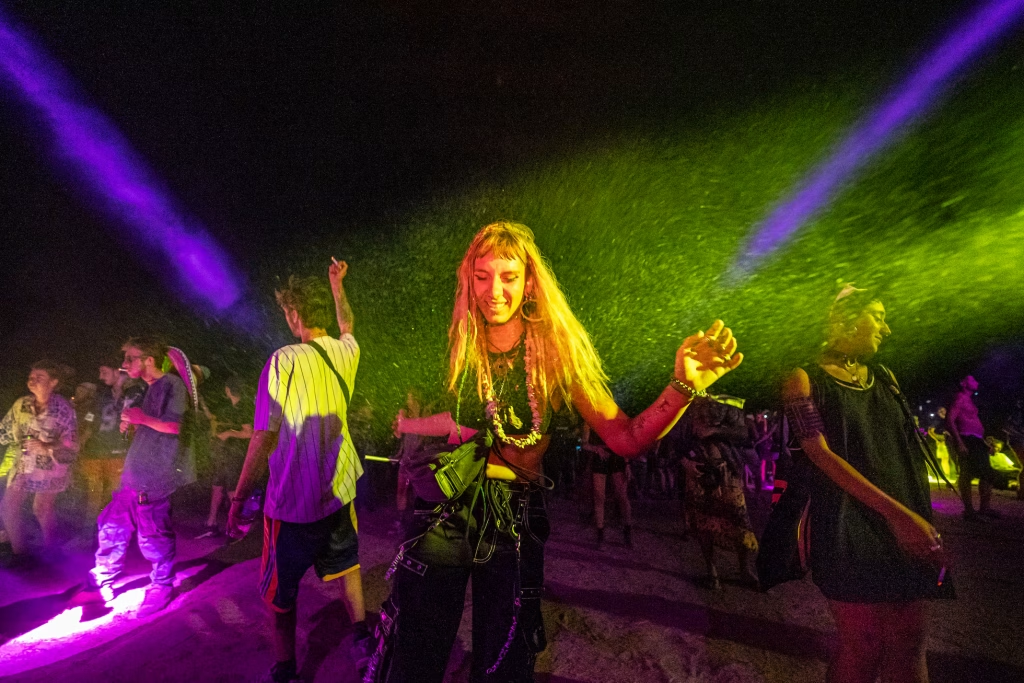
Music And Drugs: A Match Made In Heaven? Or Should We Say Hell?
If we go back to the Acid House days back in late 80s to early 90s, we find that the original UK scene was driven heavily by MDMA. The drug became central to the development of the rave subculture. Ecstasy being a staple, other drugs including Speed (amphetamines) in the early 90s as music became faster, and later Mephedrone/M-Cat.
Recent studies (2016-2019) in New York EDM scenes showed increasing trends in the use of drugs among attendees. Commonly ketamine, LSD, and cocaine.
From David Bowie and Mick Jagger, to Justin Bieber and Snoop Dogg, throughout history, drugs have been intertwined with music. What we really need to ask is what boosts this?

Rock ‘n’ roll has been sold as heavy guitar riffs and loud growls, where the musicians have a “I couldn’t care less” attitude. Does this denial need us to numb ourselves? For musicians, we agree that the high-adrenaline environment and all the movement around the stage causes a lot of fatigue. But what if we had found a better solution than booze and drugs to ease ourselves?
Conversely, the rave music scene’s fast-paced, repetitive, and bass-heavy nature is designed to create a ‘hypnotic’ effect. Stimulant drugs like MDMA are used to boost energy levels, allowing participants to dance for hours. These substances also enhance sensory perceptions, making lights, lasers, and sound more immersive.
Drugs like MDMA have often been nicknamed “love drug” as they are believed to reduce inhibitions and enhance interpersonal connections. These uses are often normalised, mostly by peer pressure, where attendees frequently share ‘that one pill’.
Live Music and Drugs: As Security Becomes Strict, The System Still Fails – What Is Going On?
The more isolated we become as a society, the more we feel the need for escape. Yes, the law is strict, but our need for escape is far more desperate. Maybe… Maybe in that moment when we see our closest ones enjoy that ‘one night’ thanks to that pill, we forget we are trading our lives for a fleeting moment.
Sure, maybe blanking out and forgetting everything will remain a memory. But since when did music start meaning numbing out instead of being in the moment? Or has the situation always been such since the good old rock ‘n’ roll days?
Would Kurt be proud of us?

Singer-songwriter and Music educator.


