


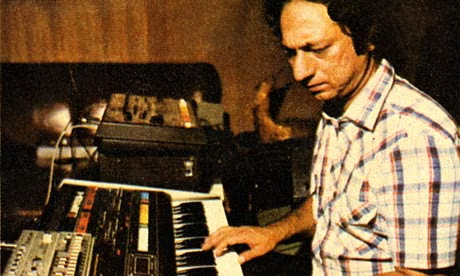
This Indian musician created a unique sound in 1982 when he combined Indian classical ragas with electronic music.
The album, Ten Ragas to a Disco Beat by Charanjit Singh, received little attention at the time. However, nearly three decades later, it gained international recognition for its unusual approach to music.
A recent article by Tara Joshi in DJ Mag looks at Singh’s musical career, his experiments with electronic instruments, and how people rediscovered his work years later.
How Charanjit Singh Started Experimenting With Music
Born in Mumbai in 1940, Singh grew up in a family that made musical instruments. He started working in Bollywood during the 1960s and played instruments for several films. He also worked with well-known composers such as R.D. Burman and S.D. Burman.
Singh took a keen interest in electronic instruments and started experimenting with synthesisers. In 1981, he released an album featuring electronic versions of songs from the film Silsila.
A year later, he decided to combine Indian classical music with electronic disco beats. In 1982, Singh recorded Ten Ragas to a Disco Beat at HMV Studios in Mumbai.
He used three electronic instruments from Roland: the TB-303, TR-808 and Jupiter-8. These instruments helped him create basslines, drum beats and melodies.
He combined the sounds with ten traditional Indian ragas. Each track followed a different raga while using electronic rhythms instead of traditional percussion instruments.
The album offered a new way to listen to Indian classical music. However, it received little promotion and did not achieve commercial success.
Charanjit Singh’s Lasting Contribution to Music
In 2002, Dutch music collector Edo Bouman came across Singh’s album while looking through records in Delhi. He found its sound unusual and later contacted Singh.
In 2010, Bouman’s label, Bombay Connection, released the album again. This time, electronic music fans around the world began paying attention.
Many listeners noticed similarities between Singh’s music and acid house, a style that emerged in Chicago during the 1980s. Some even suggested that Singh had created the sound before the genre existed.
Singh developed his music independently. His work should not take away recognition from the Black Chicago musicians who helped establish acid house.

The album’s success introduced Singh to a new generation of listeners. He began performing internationally and appeared at India’s Magnetic Fields Festival in December 2013.
Singh passed away on 4 July 2015. His music continues to attract attention, and Light in the Attic Records has also reissued his album.
His story highlights how an Indian musician experimented with electronic instruments long before his work gained wider recognition.
Original Source: Tara Joshi, How Charanjit Singh Reimagined Indian Classical Music for the Electronic Age, DJ Mag, 12 October 2026.

Writer by the day, musician by night!

